Tell me your mode and I'll tell you who you really are
Modes
Let’s see what are these modes they’re talking about and what are those made of!
Spoiler here: They are just Diatonic Major Scale with some rearrangement of its intervals.
Formulas
Think of Major scale, all scales are derived from major scale. Modes are just the reordering of the intervals of major scale.
For instance,for Dorian,start from the second and end on the first one like below.
| Formulas | I | ii | iii | IV | V | vi | vii(o) | I |
|---|---|---|---|---|---|---|---|---|
| Major (Ionian) | R | Whole | Whole | Half | Whole | Whole | Whole | Half |
| Dorian | R | Whole | Half | Whole | Whole | Whole | Half | Whole |
Intervals
Instead of using Whole and Half, I find learning intervals to get the big picture and in guitar, it makes it easier to construct scales after learning possible interval shapes.
| Intervals | I | ii | iii | IV | V | vi | vii(o) | I |
|---|---|---|---|---|---|---|---|---|
| Ionian(Major) | R | M2 | M3 | P4 | P5 | M6 | M7 | Octave |
| Dorian | R | M2 | m3 | P4 | P5 | M6 | m7 | Octave |
| Phrygian | R | m2 | m3 | P4 | P5 | m6 | m7 | Octave |
| Lydian | R | M2 | M3 | TT/#4 | P5 | M6 | M7 | Octave |
| Mixolydian | R | M2 | M3 | P4 | P5 | M6 | m7 | Octave |
| Aeolian(Rel. minor) | R | M2 | m3 | P4 | P5 | m6 | m7 | Octave |
| Locrian | R | m2 | m3 | P4 | TT/b5 | m6 | m7 | Octave |
When you analyze the modes you can easily see why in a major scale
- I IV V chords are major chords
V is actually dominant, that’s why most progressions return to tonic(I) after dominant(V).
- ii, iii, vi are minor chords and the vii is half diminished
which is also described as m7b5 chord, cause it has m7 and b5 in it.
Another use case we can deduct from the table is
- With Major7 chords play Ionian or Lydian
- With Minor7 chords play Dorian, Phrygian or Aeolian
- With Dominant7 chords play Mixolydian
- With Min7b5 chords play Locrian (Ditch it for now)
Locrian is the problem child, it is incredibly rarely used in music.
Modes of C as an example
| Modes of C | I | ii | iii | IV | V | vi | vii(o) | I |
|---|---|---|---|---|---|---|---|---|
| C Ionian | C | D | E | F | G | A | B | C |
| C Dorian | C | D | Eb | F | G | A | Bb | C |
| C Phrygian | C | Db | Eb | F | G | Ab | Bb | C |
| C Lydian | C | D | E | F# | G | A | B | C |
| C Mixolydian | C | D | E | F | G | A | Bb | C |
| C Aeolian | C | D | Eb | F | G | Ab | Bb | C |
| C Locrian | C | Db | Eb | F | Gb | Ab | Bb | C |
Notes to emphasize
Since modes are just minor or major diatonic scales with slight tweaks, to make sure to give the feeling, the tweaked notes should be emphasized playing.
Dorian (minor scale)
Dorian mode is just a minor scale but raised sixth by half, which also means using M6 instead of m6 interval. So, it is good to emphasize M6 playing Dorian to make sure it sound Dorian instead of a regular minor scale, or Aeolian in this case.
| Intervals | I | ii | iii | IV | V | vi | vii(o) | I |
|---|---|---|---|---|---|---|---|---|
| Dorian | R | M2 | m3 | P4 | P5 | M6 | m7 | Octave |
| Aeolian(Rel. minor) | R | M2 | m3 | P4 | P5 | m6 | m7 | Octave |
Phrygian (minor scale)
Phrygian mode is just a minor scale but lower 2nd by half, which also means using M2 instead of m2 interval. So, it is good to emphasize M2 playing Phrygian to make sure it sound Phrygian instead of a regular minor scale, or Aeolian in this case.
| Intervals | I | ii | iii | IV | V | vi | vii(o) | I |
|---|---|---|---|---|---|---|---|---|
| Phrygian | R | m2 | m3 | P4 | P5 | m6 | m7 | Octave |
| Aeolian(Rel. minor) | R | M2 | m3 | P4 | P5 | m6 | m7 | Octave |
Lydian (major scale)
Lydian mode is just a major scale but lower 4th by half, which also means using #4 instead of #4 interval. So, it is good to emphasize #4 playing Lydian to make sure it sound Lydian instead of a regular major scale, or Ionian in this case.
| Intervals | I | ii | iii | IV | V | vi | vii(o) | I |
|---|---|---|---|---|---|---|---|---|
| Ionian(Major) | R | M2 | M3 | P4 | P5 | M6 | M7 | Octave |
| Lydian | R | M2 | M3 | TT/#4 | P5 | M6 | M7 | Octave |
Mixolydian (major dominant scale)
Mixolydian mode is just a major scale but lower 7th by half, which also means using M7 instead of m7 interval. So, it is good to emphasize m7 playing Mixolydian to make sure it sound Mixolydian instead of a regular major scale, or Ionian in this case.
| Intervals | I | ii | iii | IV | V | vi | vii(o) | I |
|---|---|---|---|---|---|---|---|---|
| Ionian(Major) | R | M2 | M3 | P4 | P5 | M6 | M7 | Octave |
| Mixolydian | R | M2 | M3 | P4 | P5 | M6 | m7 | Octave |
Aeolian (natural minor scale)
Aeolian mode is the natural minor scale itself for the root note. Just look how guide notes replaced with minors instead of majors. iii and vii are called as guide notes, but also be aware of the vi notes is also using minor. So we can say, except I, IV and V all notes are using minor intervals, that’s why it is called minor scale in the end.
| Intervals | I | ii | iii | IV | V | vi | vii(o) | I |
|---|---|---|---|---|---|---|---|---|
| Ionian(Major) | R | M2 | M3 | P4 | P5 | M6 | M7 | Octave |
| Aeolian(Rel. minor) | R | M2 | m3 | P4 | P5 | m6 | m7 | Octave |
Minor Scales
There are three primary minor scale namely, natural, which we already know as Aeolian, harmonic minor and melodic minor. Look how melodic and harmonic minor derived from major scale. This is the point which i understand more every possible scale is derived from major scale.
| Intervals | I | ii | iii | IV | V | vi | vii(o) | I |
|---|---|---|---|---|---|---|---|---|
| Ionian(Major) | R | M2 | M3 | P4 | P5 | M6 | M7 | Octave |
| Melodic | R | M2 | m3 | P4 | P5 | M6 | M7 | Octave |
| Harmonic | R | M2 | m3 | P4 | P5 | m6 | M7 | Octave |
I also put Dorian below there cause they are so close to each other. Since each scale has its modes inside, Harmonic and Melodic minor has modes itself to be discovered later on.
| Intervals | I | ii | iii | IV | V | vi | vii(o) | I |
|---|---|---|---|---|---|---|---|---|
| Natural(Aeolian) | R | M2 | m3 | P4 | P5 | m6 | m7 | Octave |
| Harmonic(Yngwie ) | R | M2 | m3 | P4 | P5 | m6 | M7 | Octave |
| Melodic(Jazz) | R | M2 | m3 | P4 | P5 | M6 | M7 | Octave |
| Dorian(Funk/Blues) | R | M2 | m3 | P4 | P5 | M6 | m7 | Octave |
I think I got too far before learning basics in this post. So, I will stop here with the modes and go back to basic in my next post. Anyway, It made me happy to see the structure and understand how modes are made up. At the end, what I can say is The Diatonic Major Scale is the one to rule them all!
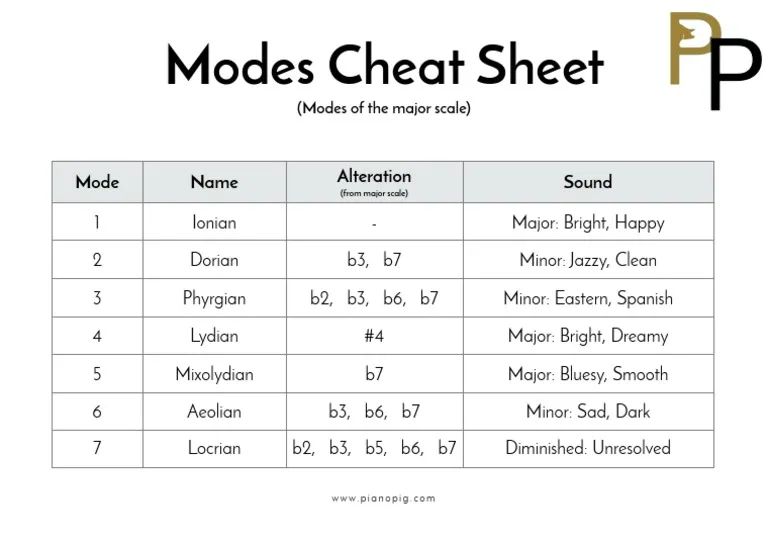
TLDR; Practical Modes Summary
Instead of memorizing every mode from scratch, I find it much more practical to think of modes as small alterations of familiar major or minor scales. This makes it easier to recognize them on the fretboard and apply them musically.
Major-Based Modes
Ionian (Major)
Just the regular major scale. No changes.Lydian
Major scale with a raised 4th
→ Think: major + $4Mixolydian
Major scale with a lowered 7th
→ Think: major + b7
Minor-Based Modes
Aeolian (Natural Minor)
The standard minor scale. No changes.Dorian
Minor scale with a raised 6th
→ Think: minor + M6Phrygian
Minor scale with a lowered 2nd
→ Think: minor + b2
The Problem Child
- Locrian
Minor scale with a lowered 2nd and lowered 5th
→ Think: minor + b2 + b5
(Very unstable and rarely used—safe to ignore for now.)
 Modes Cheat Sheet
This way of thinking helped me stop treating modes as something mysterious.
They’re not new scales—they’re small twists on scales we already know.