Ditch me baby one more time! Barrel files disaster!

How Ditching Barrel Files Reduced My Bundle Size by 95%
A few weeks ago, while analyzing one of my dApp projects, I stumbled upon something that completely changed how I think about barrel files.
What started as a small optimization experiment turned into a massive performance boost — bundle sizes dropped from over 5 MB down to just ~250 KB per route.
Here’s the breakdown 👇
The Discovery
It started with curiosity.
The app was running fine, but builds felt slow and the final bundles seemed too large for the actual codebase.
So I cracked open the Next.js bundle analyzer to see what was going on.
Those two articles were eye-opening.
They explained how barrel files — the handy index.ts files that re-export modules — can actually hurt tree-shaking and cause the bundler to include entire modules unnecessarily.
After realizing this, I decided to test the impact by removing barrel file imports from a few internal packages that contained ABIs, contract JSONs, and utility code.
What Are Barrel Files (and Why They Hurt)
A barrel file is a convenience pattern that gathers and re-exports modules.
For example:
1
2
3
4
// index.ts
export * from "./Button";
export * from "./Card";
export * from "./Modal";
This looks tidy at first glance — you can import everything from a single entry point:
1
import { Button, Card } from "@/components";
But there’s a hidden cost.
When the bundler (like Webpack or Vite) sees this structure, it often can’t determine which exports are actually used — so it keeps them all.
That means even if you only import one function, the entire module tree gets included in your bundle.
The Experiment
After identifying a few heavy offenders in my codebase, I decided to remove all barrel file imports and replace them with direct imports.
Instead of:
1
import { Wallet, Contract } from "@/lib/core";
I switched to:
1
2
import { Wallet } from "@/lib/core/wallet";
import { Contract } from "@/lib/core/contract";
Then I built the app again and compared snapshots using the bundle analyzer.
The Results
The results were staggering.
In short, every single route saw a 90–97% reduction in bundle size.
From ~5 MB per page down to ~250 KB — all by just removing barrel imports.
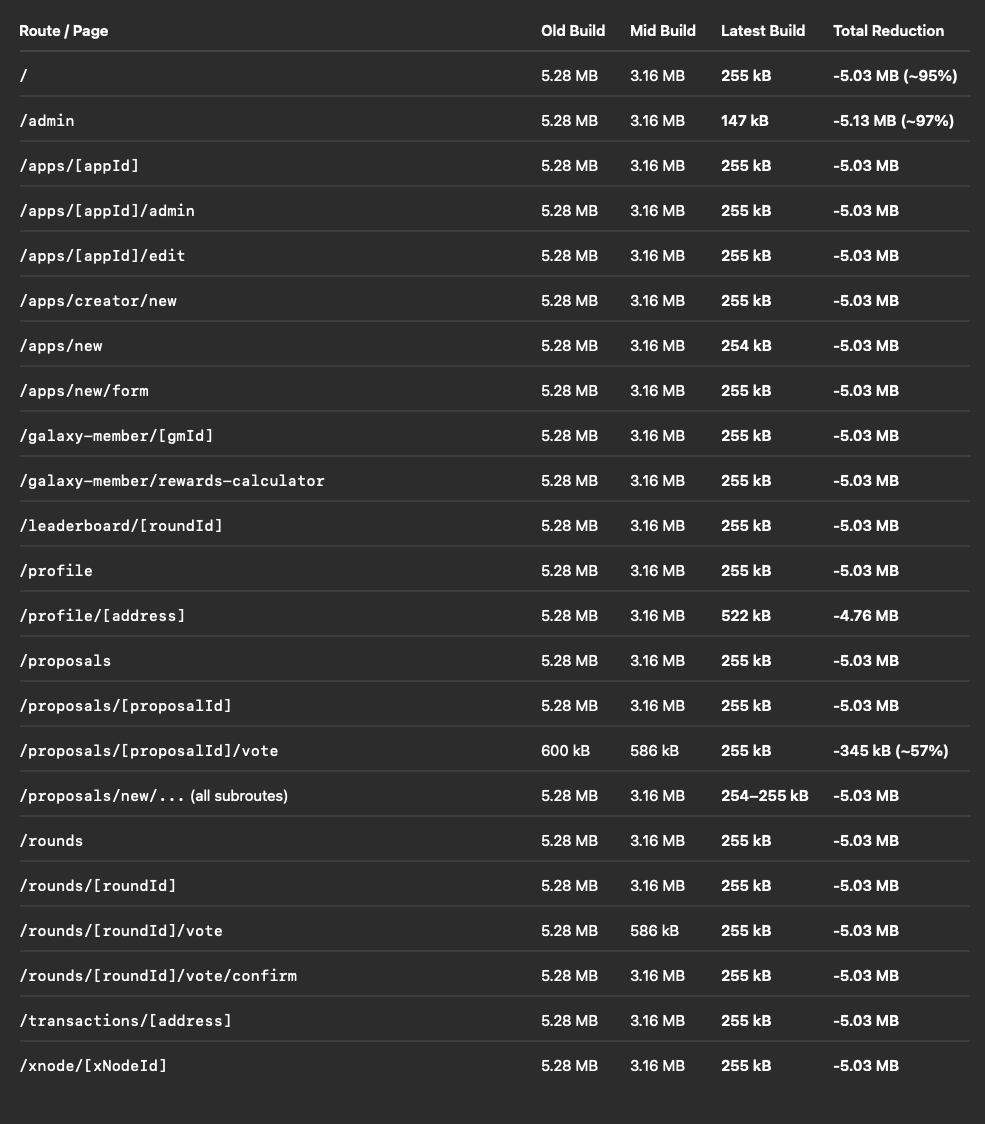
That’s a huge win for both performance and developer experience — smaller builds mean faster deploys and lighter pages for users.
Visualizing the Impact
To understand what was still taking up space, I dug deeper with the bundle heatmap.
It helped visualize which modules were still contributing most to the bundle size — in my case, a few large contract factory files and generated ABIs.
Even after optimizing, there were still opportunities for improvement — like modularizing ABI exports or lazily loading contract definitions.
Takeaways
If you’re maintaining a modern web app, SDK, or library, here are a few lessons learned from this experience:
Avoid barrel files — especially in shared libraries or packages.
They make code look cleaner but can silently destroy tree-shaking.Measure, don’t guess.
Tools like@next/bundle-analyzerorwebpack-bundle-analyzergive you concrete insight into what’s bloating your builds.Be careful with JSON and ABI exports.
Large contract or data exports can dominate bundle size if not modularized.Prefer explicit imports.
They might look verbose, but they give bundlers the clarity they need to exclude unused code.
Final Thoughts
Sometimes, the biggest performance bottlenecks come from the smallest patterns.
A single index.ts file may seem harmless, but it can quietly add megabytes to your production build.
After this experiment, I’ve started avoiding barrel files entirely — especially in libraries.
The result? Smaller bundles, faster builds, and happier users.
🧠 Pro Tip
If you’re curious whether your app is affected, install the Next.js Bundle Analyzer and take a look.
You might be surprised by what’s hiding inside your build.